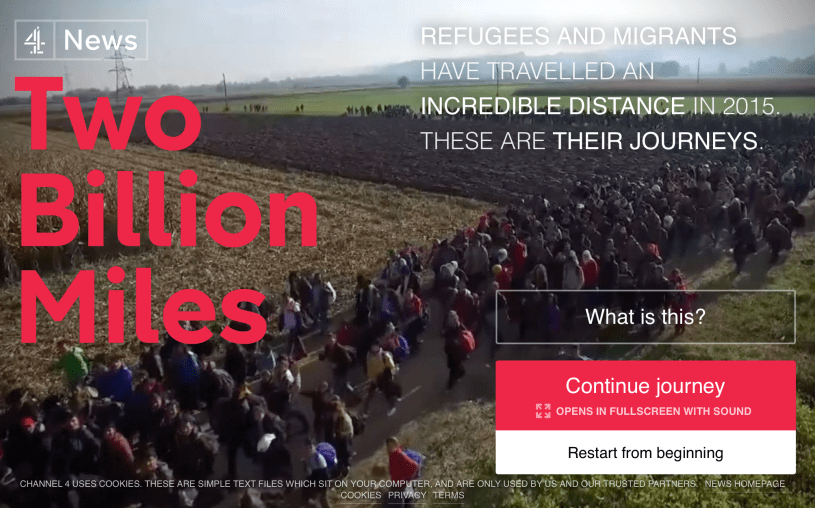
The world still endures the effects of the European migrant crisis today. By the end 2016, almost 5.2 million refugees and migrants had arrived in Europe due to war and conflict in their home countries. This was and is a crisis surrounded by xenophobia. Populist parties in many European countries have gained momentum by taking ant-migrant stances in the last few years. Despite this, there were efforts made attempting to humanize this crisis. Looking back, we can see how journalists tried to put a face to the millions forced to leave their homes, and to encourage readers to put themselves in their shoes.
In November of 2015, Channel 4 News released an interactive video story called “Two Billion Miles.” This was a user-lead experience that took the user through the situations and decisions a refugee may be faced with on his or her journey to asylum in Europe. The user begins their interactive journey in one of six locations (Iraq, Somalia, Eritrea, or one of three different cities in Syria). Due to lack of safety and/or inadequate living conditions, the user is forced to leave their starting city. From then on, the user is given choices that they must select from in order to further their journey. The choices attempt to simulate the decisions that actual refugees and migrants had to make on their journeys to and through Europe, and all of the footage shown belongs to Channel 4 News. I completed the journey numerous times in order to explore the different options and trajectories.
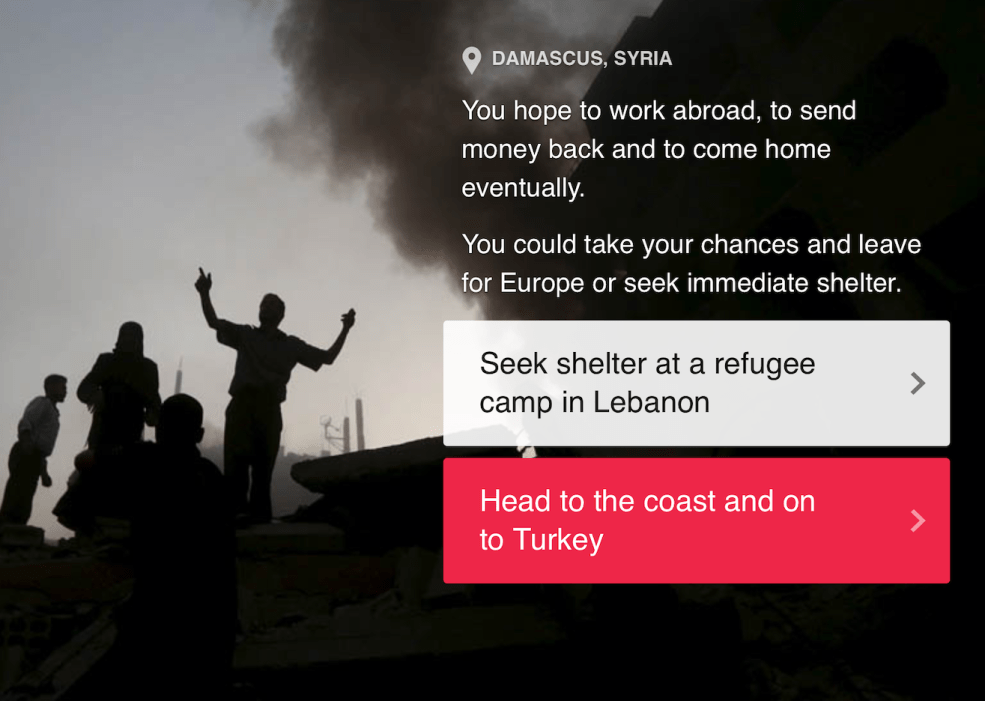
My first journey begins in war-torn Aleppo, Syria. I am forced to migrate to Damascus, where I live in a one-room, half-built apartment with my family of seven. I then must leave again, presented with the choice of seeking shelter at a refugee camp in Lebanon, or heading to the coast and onward to Turkey. I choose to travel to Turkey.
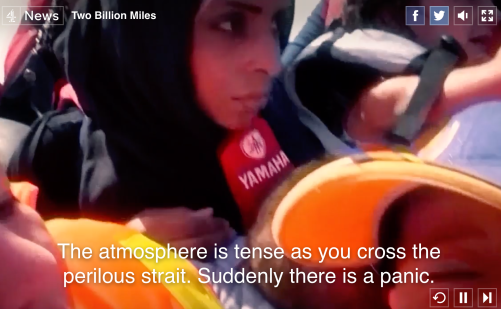
Once I arrive, I have to make the decision between the long and risky land-route to Europe, or the shorter but dangerous (and expensive) sea-route. I am told that 12 people drowned on their way to Greece the night before. I choose to take the dinghy to Greece anyways, which costs 750 pounds that I must eventually pay back to my friends and family. While on the dinghy, I see shots and closeups of the other refugees on the boat, giving me a sense of how crowded and uncomfortable it is.
In Greece, I am surprised to see so many fences, as I had been told refugees were welcome there. I am unable to register myself, forcing me to leave for Italy. I then have to make the choice between going straight to Rome or temporarily resting in a migrant camp. I owe thousands to my family at this point, so I choose to go to Rome in the hopes of earning money.
In Rome, I end up living in a shanty town where many Eritrean refugees are living. However, I am not wanted in Italy. I have no choice but to head north, as southern European countries are not settling enough refugees. I travel to Austria, where I am given the choice of continuing on to one of four German cities: Munich, Rosenheim, Dortmund or Stuttgart. People are saying that Germany is expected to take in 800,000 refugees this year, so I am hoping this will be my last destination. I choose to go to Stuttgart, where there is a hostel said to be taking asylum seekers. Then I find that it was burned down in one of 150 arson attacks on migrants’ housing in Germany that year.

Due to the fact that Germany is overwhelmed by refugees, I choose to leave and travel to Calais, France. After months of waiting for accommodation, as well as an attempt to travel to Great Britain, the French government finally claims me and I am given housing for 3 months. My journey ends with me thinking back to my friends and family, who unlike me were not able to escape the danger and suffering back home.

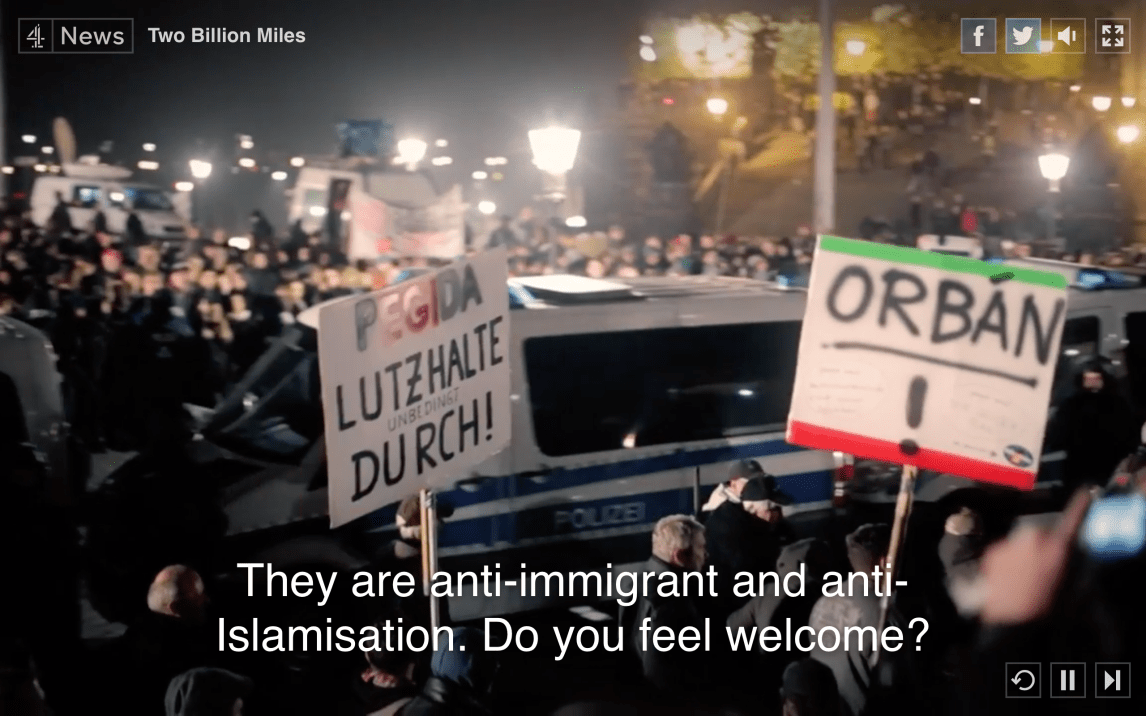
The other journeys I completed were similar. I was often forced to leave European countries upon arrival, and others I left after being met with xenophobia, persecution and lack of opportunity. The land routes to Europe were also treacherous. Refugees ran the risk of being caught by police and often were left with no choice but to search for holes in borders in order to continue. The endings were usually bittersweet. Just because I was finally able to settle in a country, it did not mean that I was welcome there. For instance, one of my journeys ended in Munich, where frequent anti-migrant protests were occurring. The video asked me at one point, “Do you feel welcome?”
I felt that this interactive experience was executed effectively. It achieved its intent, as it was easy to put myself in the position of a refugee when I was forced to make the choices myself in order to complete the activity. It also included clips, images and brief interviews that contributed to my ability to imagine myself in those circumstances. Certain moments definitely stood out to me. For instance, when I was on the dinghy to Greece, the shots they chose to show gave the sense of a claustrophobic and crammed setting, and the expressions on people’s faces alluded to the fear and uncertainty that they were experiencing.
The response to this interactive video was overwhelmingly positive. In 2016, it won best in video journalism for the The Drum’s Online Media Awards. Films For Action called it “extraordinary.” Many reviews commended Channel 4 News for creating such a unique outlet to utilize its footage and raise awareness.
I also thought Channel 4 News took an interesting approach with the message they were sending about refugees. The headline on the main page for “Two Billion Miles” states, “Refugees and migrants have travelled an incredible distance in 2015. These are their journeys.” In Channel 4 News’s description of the interactive video story, it’s described as featuring “real footage from extraordinary journeys made this year.” Through words like “incredible” and “extraordinary,” they’ve chosen to portray migrants not only as people who are suffering, but as people who are strong and have accomplished something significant. I think this was an attempt to reshape the public’s view of refugees. Channel 4 News wanted the audience’s sympathy as well as its admiration. In my opinion, this was an effective tactic to humanize refugees and give people a reason to support their success in Europe.
Overall, this was an innovative and highly effective piece of journalism. Channel 4 News managed to showcase powerful, high quality footage in junction with a compelling interactive story that proved emotionally moving for the user.
 Caroline Cox