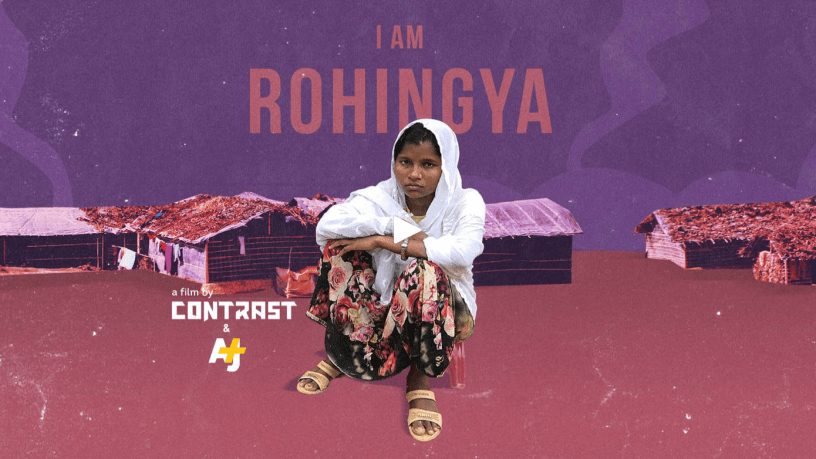
Since August 2017, nearly 700,000 Rohingya people have fled their homes in the northern province of Myanmar for neighboring Bangladesh. Rohingya Muslims are an ethnic minority in Myanmar, which is a predominantly Buddhist country. The government has refused to recognize them as citizens and even excluded them from the 2014 census. In what the United Nations has classified as ethnic cleansing, Myanmar’s military has committed atrocities such as mass killings, sexual violence and widespread arson towards the Rohingya community. Now, the Rohingya make up one of the largest stateless populations in the world.
In partnership with Amnesty International, Contrast VR collaborated with AJ+ to create and publish “I am Rohingya,” an interactive user experience centered around the story of one Rohingya woman’s life. The project can be viewed in VR or in 360-degree viewing, which gives the user the control to navigate the video as a panorama. The footage is presented through the visual perspective of the user, who has the ability to look to the left, right, up or down as they please.
The experience begins in a moving wagon. There are three people facing the camera; a young women and two young boys. The landscape surrounding is dry and barren. The young woman starts speaking in a foreign language, and the English translation quickly follows. The woman explains that she and her two sons are new to this place (a camp in Bangladesh). She says she came here after being persecuted in her home country of Myanmar, and that God has made it possible for her to tell you her story and that she hopes you will tell it to others.
The screen then cuts to a landscape. Text appears, and the user must turn through the landscape in order to read it. It explains how tens of thousands of Rohingya have fled Myanmar for Bangladesh due to military violence, and that no other country will resettle them. Myanmar’s icon of democracy Aung San Sua Kyi has not spoken against the violence.

The Rohingya woman begins speaking again. Her name is Jamalida, and she is 26-years-old. She lives in this refugee camp in Bangladesh. She says some call the Rohingya the “most unwanted people in the world.” Then the screen cuts to a yellow truck surrounded by many people, while Jamalida continues narrating. She says some people have lived in the camp for their whole lives. Then she and a small group of people are shown dancing, as she explains that their dresses were donated by the local people.
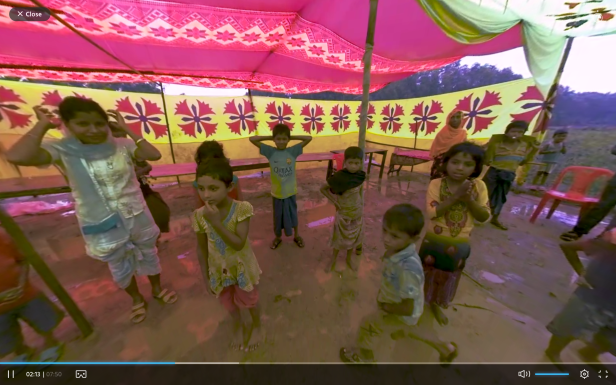
Then her two sons are shown playing in the dirt. She says that she is happy when she sees her children play, but she feels terrible when they are unhappy; “as if the sky might collapse on the earth.” She explains that back home she had a job, as she used to check on babies in her village. Now she has no job, and her days consist of taking care of her kids and doing chores.
Then the screen cuts to Jamalida cooking in a rudimentary structure. She says that when she cooks, she thinks about Myanmar. There, she was able to eat vegetables and fish. Now she only eats once a day and it is mostly just rice. She says she wonders where her next meal will come from. Looking around the room, you can see that the walls are made of sticks and tarps, and the floor where she cooks in made of dirt.

Then footage of a larger room appears, where Jamalida, her sons and others are sitting on the floor. She begins, “My sons remind me of their father. They found his body lying by the side of the road. They did not realize their father was dead. They thought he was just sleeping.” Then the screen shows Jamalida standing by a muddy river, with her eyes closed. “When I close my eyes, memories start pounding up.”
Then, the landscape turns black and white. However, animated orange flames begin to appear in the background. The sequence is meant to be a flashback to Jamalida’s memories in Myanmar. She says she heard sounds “like war” and she could not find her husband. Then all the villagers fled. When she returned to the village, “her home, lifelong savings and her entire dreams had turned to smoke and ashes.” “Everything was destroyed,” she says. “It hurts me that I could not bury my husband’s body. I feel that he’s still lying there.” In the background, there are sounds of quiet weeping.

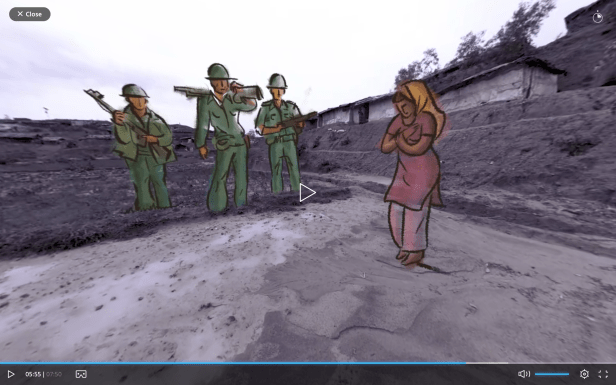
An animated man is shown lying by the river. Jamalida explains that the soldiers came back and beat them, citing that they were looking for terrorists. She says that three soldiers called her over and she knew they wanted to rape her. They stripped her clothes off, and while she was being violated she wished that she could die. Afterwards, she laid down on the ground naked under the sun.
The scene cuts back to the present and shows her and her children walking. She says they are the reason she has survived and that God kept her alive for them. As she sits by the river and her son plays beside her, she says “If I collected all of our tears, it would fill this river.” She concludes on an inspirational note, saying she is determined to “keep dancing.” The screen then cuts to black and text appears again. It says that a cyclone had recently destroyed parts of the refugee camp, but Jamalida and her sons evacuated and later returned safely. She now works as a volunteer helping to distribute food. The experience ends with the message, “No Rohingya has been resettled in another country since 2012.”
Overall this was a successful piece of journalism. The sequence of the experience helped the audience to understand Jamalida’s story in a moving and effective way. Her character brought a wide array of emotion to the experience, as she was someone who had experienced horrific tragedy, but was inspirational in that she persevered for her children. The project was also diverse in content. The use of animation at certain parts in the story helped to make the experience less traditional and more visually interesting. The project has resulted in over 1.5 million views, and was shown at numerous respected venues in including both Vancouver’s and Rio’s International Film Festivals. RAW in WAR (Reach All Women in War) recognized Jamalida as a “Brave Voice Refusing to be Silenced” during their 2018 awards ceremony.
I think the experience is naturally more effective when viewed in VR, rather than in 360-degree. This allows you to feel as if you are there with Jamalida in the camp on a heightened level. The project itself does an excellent job at presenting Jamalida and the Rohingya people as a group who has suffered immensely and unjustly. It effectively sheds light on an ongoing humanitarian crisis that many people may not know much about.
 Caroline Cox